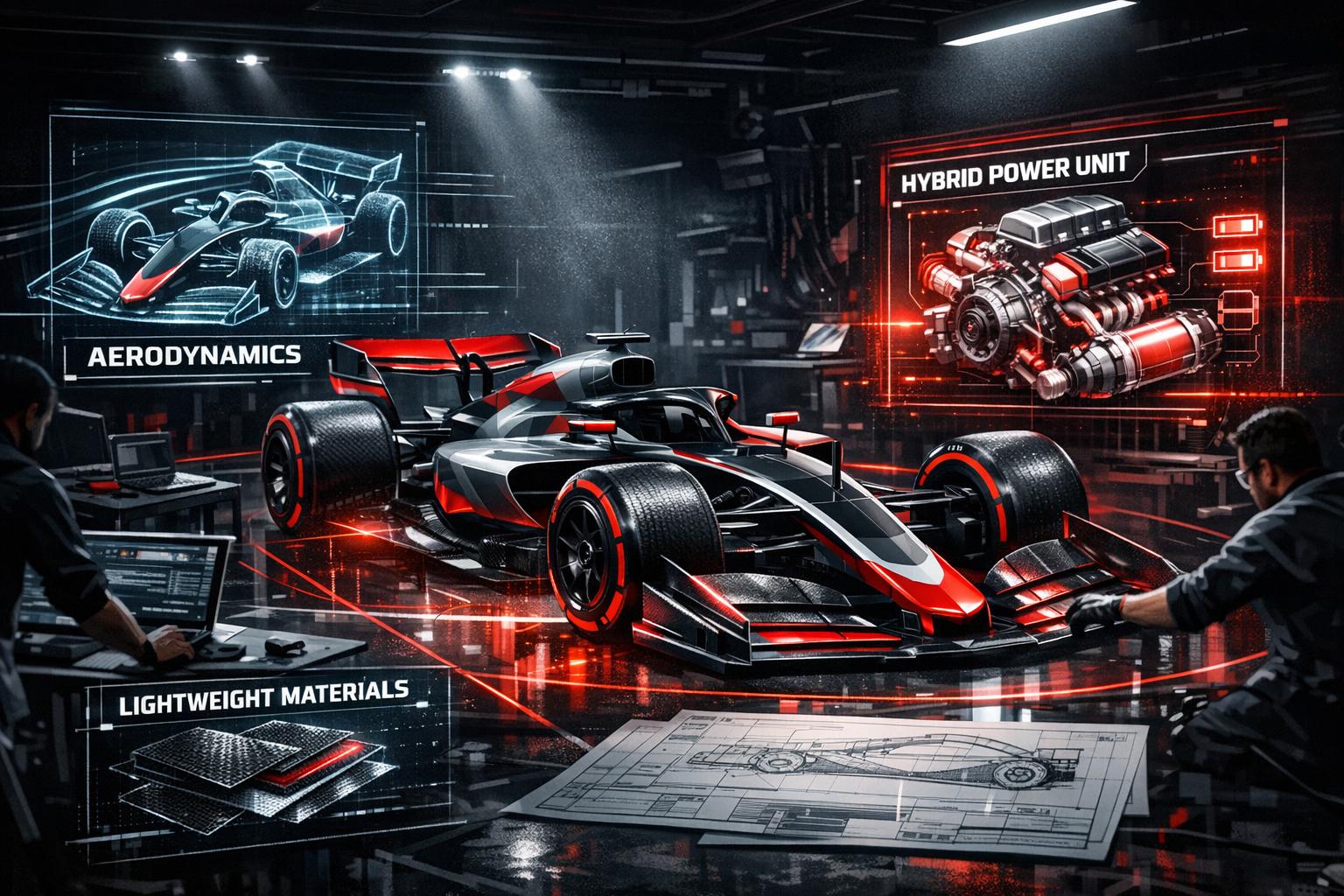
How Regulation Changes Impact F1 Development
How 2026 F1 rule changes — active aerodynamics, hybrid power overhaul, sustainable fuels and lighter cars — force teams to redesign, strategize and adapt.

How 2026 F1 rule changes — active aerodynamics, hybrid power overhaul, sustainable fuels and lighter cars — force teams to redesign, strategize and adapt.

Budget caps and ATR forced F1 teams to shift from spending to engineering efficiency, prioritizing high-impact aero upgrades, advanced CFD and 2026 prep.

How Drive to Survive grew F1's audience while dramatizing and sometimes fabricating rivalries, prompting driver criticism and demands for accuracy.

How top F1 teams blend driver feel with telemetry to refine setups, diagnose handling issues, and maximize on-track performance.

How F1 teams use telemetry and ML (XGBoost, neural nets, Bayesian) to forecast tire wear, guide pit stops, and improve race strategy.

Inside the choreography, tools, and training behind sub-2-second F1 pit stops: crew roles, laser parking, pneumatic guns, jacks, and relentless practice.

F1's 2026 switch to 100% sustainable fuel could raise per-liter costs nearly tenfold, pushing team fuel bills higher and forcing budget and technical shifts.

Explore the challenges and strategies of the 2025 Singapore Grand Prix, including track layout, tire management, and night racing conditions.

Explore the evolution of Singapore's Marina Bay Circuit, the first night race in Formula One, and its lasting impact on motorsport and tourism.

Lewis Hamilton's move to Ferrari marks a new chapter in his career as he aims for an eighth title while adapting to a revamped team and car dynamics.

F1 cars are not four-wheel drive; they rely on rear-wheel drive for performance, handling, and compliance with regulations. Learn why RWD is essential.
Daily F1 newsletter with deep dives into Formula One’s strategies, stories, and tech.

A concise history of F1 tire warmers, their impact on grip, safety and strategy, and how regulations and new tire tech are driving a phase-out.

Telemetry lets F1 teams predict failures and extend component life by combining real-time sensor feeds, AI models, and digital twins.

Tire tech shaped Formula 1's performance, safety and strategy — from 'tire wars' to one supplier focused on planned degradation and greener materials.

Clear guide to FIA ERS rules and 2026 changes: MGU-K power jump, energy limits, safety upgrades, homologation, telemetry monitoring and enforcement.

How changes to braking zones and DRS at Bahrain, Barcelona and Yas Marina reshape overtaking, strategy, and safety in F1 races.

How F1 teams cut telemetry latency using edge computing, tiered storage, Kafka, optimized networks and error correction for real-time race decisions.

Tire temperatures control grip, wear and pit strategy; how teams target a 90–110°C sweet spot to optimize stints and race decisions.

How MGU-K and MGU-H recover and deploy energy on high-speed F1 tracks, and what the 2026 MGU-H removal means for hybrid power.

F1's 2026 power units shift to 50% electric, 100% sustainable fuel, doubled energy recovery, and active aero — reshaping race strategy and road-car tech.

Banned rear‑wing innovations — T‑wings, shark fins, mini‑DRS and beam wings — reveal the clash between aerodynamic gains, safety and fair racing.

Checklist for meeting F1's 2025 flexi-wing rules: Article 3.15 limits, 75 kg rear‑wing and 30 N slot‑gap tests, FEA, static/wind‑tunnel validation and race monitoring.

How F1 cars collect, filter and transmit ~1.1M sensor data points/sec using on-car CAN networks, encrypted wireless telemetry, and factory links.